
Dispatches From the Empire: The Empire They Inherited
How Older Generations Built the Crisis Younger People Now Face
I. Introduction: The Question That Revealed a Larger Truth
I recently hosted a book signing for my new work,The Synthetic Empire-The Rise of Corporate Rule, the Fall of Democracy and the Path to Reclaim Our Future, which included a panel discussion with Dr. David Leon Reed, Assistant Professor of History at Bowie State University and Adjunct Professor of History at Bowie State University and Assistant Professor at Howard University. During the Q&A portion of the program, an audience member raised a question about Millennials and Generation Z (Gen Z) and their perceived lack of engagement in the broader struggle to confront the forces shaping what I describe as the Synthetic Empire. The room, composed mostly of attendees over fifty, responded with a familiar refrain—one I have heard for decades—placing responsibility for societal decline squarely on the shoulders of younger generations. Once again, I was struck by the disconnect and the lack of awareness, insight, analysis, and empathy that often shape these critiques.
What struck me most were not the comments themselves but the familiarity of them. The critiques reflected my long-observed patterns: older generations misattributing a problem they created, while overlooking the realities younger people have inherited. The consistency of the narrative is as revealing as it is troubling. Older Americans often speak with certainty about what Millennials and Gen Z “aren’t doing,” rarely recognizing or acknowledging the vastly different conditions these younger cohorts have to navigate. As I responded to the audience, I was reminded of the years I spent conducting empirical research for my doctoral dissertation. My doctoral dissertation involved empirical analysis of generational differences, including how various age groups perceive their surroundings, interpret social conditions, form their sense of agency, and respond to the pressures of their time. The disconnect I observed aligned with what my research uncovered. Older generations interpret younger people’s behavior through the lens of a world that no longer exists, and that they were responsible for dismantling.
Further consideration of the deep-rooted nature of these perceptions makes the generational tension clearer. Many older Americans interpret the behaviors of Millennials and Gen Z through a framework shaped by their own experiences—experiences defined by affordable higher-education, more stable employment, accessible homeownership, and a social contract that, while imperfect, still offered a predictable path toward stability. That framework no longer exists, yet the expectations remain firmly in place. What I heard during the Q&A was not simply criticism of younger people but a longing for a world that has disappeared, paired with a reluctance to acknowledge how policy decisions, cultural shifts, and economic priorities over the last several decades—decisions largely made by older generations—contributed to that disappearance. This disconnect represents a generational blind spot: older adults see younger people’s choices as personal failings rather than rational responses to structural conditions that have fundamentally changed over the last several decades. The assumption that younger generations are apathetic has become a convenient explanation for older adults who are struggling to make sense of a world that no longer resembles the one they came of age in. But what is often labeled as apathy is actually a rational response to societal declines over the past several decades. Millennials and Gen Z are not disengaged because they lack ambition or commitment. They are navigating an economic environment defined by stagnant wages, unstable employment, unaffordable housing, unprecedented debt burdens, and a social landscape marked by violence, polarization, and digital distortion. Their choices—whether to delay marriage, avoid long‑term employment, question traditional institutions, or reject the myth of the American Dream—are not signs of indifference. They are signs of clarity. They reflect adaptations to a system that no longer offers the stability, mobility, or security that older generations once took for granted. To interpret these choices as apathy ignores the daily realities younger people confront and overlooks the role older generations in their creation.
Older generations often carry expectations that were shaped in an era of greater stability, which color their interpretations of younger people’s choices. Many older generations still assume that hard work reliably leads to upward mobility, that loyalty to an employer is rewarded, that homeownership is the natural next step into adulthood, and that institutions—government, education, religion, civic organizations—remain trustworthy anchors of community life. These assumptions persist even though the underlying conditions that once made them reasonable have eroded. What I heard during the Q&A was not simply frustration with younger generations but insistence that the old rules should still apply, even though the game itself has fundamentally changed. This insistence creates a moral inversion: older generations expect younger people to thrive within dysfunctional systems, and when they don’t thrive, their failures are attributed to character rather than circumstance. It is a critique rooted not in evidence, but in nostalgia for a world that no longer exists—and in some cases, never existed as equitably as memory suggests.
Older generations often cling to expectations that no longer align with the economic and social realities they helped shape. What goes unacknowledged is how deeply those expectations are rooted in a period of relative stability—when wages kept pace with the cost of living, long‑term employment was rewarded, homeownership was attainable on a single income, and institutions still carried enough legitimacy to anchor a sense of civic belonging. Yet many older adults continue to insist that young people operate in similar conditions which should still allow the same outcomes. This insistence creates a powerful distortion: it allows older generations to interpret younger people’s adaptive behaviors—job‑hopping, delaying major life milestones, distrusting institutions— as evidence of personal deficiency not adaptations to structural decline. In doing so, they preserve a comforting narrative about their own success while avoiding the harder truth that the systems they stewarded have failed to deliver the same opportunities to their descendants.
II. Exploring How We Got Here (The Causes): Tracing the Roots of the Generational Divide
The generational divide that shapes our society today did not emerge overnight; it is the result of persistent value drift and enaction of short-sighted policies over decades. Understanding the roots of this divide requires tracing the interplay between cultural shifts, policy decisions, and the evolving expectations that shape each generation’s experience. Each generational era—marked by its own social attitudes, economic strategies, and political priorities—laid building blocks that ultimately widened the gap between older and younger generations. The collective optimism of the postwar era gave way to the rise of hyper-individualism in the 1980s. The rise of hyper-individualism included embrace of policies that prioritized present gains over future stability, which have redefined what it means to live, work, and dream in America. Thorough examination and honest reflection of this path makes clear that the challenges facing Millennials and Gen Z are not the result of apathy or personal deficiency but the predictable outcome of the actions and inactions by prior generations.
Culture: Hyper-individualism and Consumption
The “Me Generation” and the Culture of Consumption:The 1980s stand as a pivotal decade in the evolution of American society—a period when cultural attitudes and economic policies converged to reshape both the lived experience and the expectations of generations to come. This decade marked a distinct departure from the collective ethos that had characterized postwar America, giving rise to a new value system rooted in individualism and immediate gratification. Tom Wolfe famously captured this transformation with his “Me Generation” critique, identifying a shift toward self-interest and consumerism that would become a defining feature of the period.1 Alongside this cultural shift, the decade witnessed a significant rise in hyper-individualism and a decline in collective responsibility as Americans increasingly prioritized personal advancement over communal well-being. These trends were reinforced and amplified by sweeping deregulation; credit expansion; and the normalization of debt, which fundamentally altered financial habits and societal expectations.2
Buy Now Pay Later: The Normalization of Debt: At the heart of this cultural shift was the expansion of a “buy now, pay later” mentality. The proliferation of credit cards, the normalization of personal debt, and the promise of instant gratification fundamentally altered how Americans approached consumption.2 No longer was thrift or delayed reward the prevailing wisdom; instead, the culture increasingly celebrated acquisition and lifestyle as markers of success. This transformation was not merely a matter of changing tastes—it reflected deeper shifts in economic policy and social priorities. Deregulation of the financial sector made it easier for consumers to access credit, fueling a cycle of debt that became embedded in everyday life.3
Policy Choices: Choosing the Present Over the Future
Transition from Keynesian to Supply-Side Economic Policies: The economic philosophies guiding national policy underwent a dramatic change during this period. The Keynesian consensus, which had emphasized broad-based prosperity, government intervention, and social safety nets, gave way to supply-side theories that prioritized deregulation, promoted tax cuts, and emphasized market-driven growth.4 The “if you build it, they will come” mentality encapsulated the optimism of this new approach: the mentality that unleashing entrepreneurial energy and reducing regulatory barriers for businesses would inevitably lead to widespread benefits for society. Yet, the shift in focus toward incentivizing investment and consumption at the expense of collective welfare4 also signaled a deprioritization of equity. The expansion of credit and the normalization of debt were not simply economic strategies—they were cultural signals that reinforced the era’s hyper-individualism, encouraging Americans to pursue personal fulfillment through consumption, often with little regard for the broader individual or social consequences.6
The consequences of these decisions reverberate through the structural realities facing Millennials and Gen Z today. The decline in stable employment, the collapse in housing affordability, and the explosion of consumer debt are not accidents or coincidences but outcomes of a long arc of cultural and policy choices.5 The 1980s did not simply mark a turning point—they set the trajectory for a society increasingly defined by individual risk, market volatility, and the normalization of precariousness. Understanding this legacy is essential for grasping why younger generations confront a world so fundamentally different from that which older Americans recall. The erosion of collective responsibility and the embrace of hyper-individualism left younger generations with weakened social safety nets and a culture that expects individuals to bear risks alone, further compounding the challenges they now face.
Deregulation of Finance, Housing, and Labor Markets: The era beginning in the 1980s witnessed sweeping deregulation across America’s financial, housing, and labor markets—changes that fundamentally reshaped the nation’s economy and contributed to the generational divides seen today. In finance, the Depository Institutions Deregulation and Monetary Control Act of 1980 phased out interest rate caps and allowed banks to compete more aggressively, setting the stage for the proliferation of new financial products and widespread credit expansion.6,7 This was followed by the repeal of the Glass-Steagall Act’s core provisions through the Gramm-Leach-Bliley Act of 1999, which removed the separation between commercial and investment banking, paving the way for the rise of “too big to fail” financial institutions and increased systemic risk.8
Housing markets underwent similar transformation, most notably with the loosening of lending standards and the expansion of subprime mortgages. The Financial Institutions Reform, Recovery, and Enforcement Act (FIRREA) of 1989 restructured the savings and loan industry in response to its crisis, but subsequent policies and regulatory inaction in the late 1990s and early 2000s allowed for the rapid growth of mortgage-backed securities and risky lending practices. These shifts played a central role in fueling the housing bubble and the eventual crash of 2008.10
Labor markets, too, saw significant deregulation. The decline in union density was driven in part by policy and legal decisions that weakened collective bargaining rights and empowered employers. The shift toward “at-will” employment, the rise of contract and gig work, and the rollback of certain worker protections all contributed to greater job insecurity and volatility for American workers.11 These combined trends—deregulated finance, housing, and labor—collectively increased individual risk, reduced economic stability, and have had lasting effects on younger generations’ ability to build wealth and security.
The Rise of Tax Cut Policies: The trajectory of American tax policy since the 1980s has been profoundly shaped by a series of tax cuts enacted during the tenure of Boomer leaders, beginning with President Ronald Reagan and extending into recent legislative efforts such as the Build Back Better (BBB) proposals. These tax cuts were emblematic of the broader shift toward supply-side economics, which prioritized deregulation, reduced government intervention, and the belief that lowering taxes—particularly for corporations and high-income earners—would stimulate investment and economic growth.
The Reagan Era: The Economic Recovery Tax Act of 1981 marked the first major tax overhaul of the era, reducing the top marginal income tax rate from 70% to 50%, and later to 28% by the end of Reagan’s presidency. These policies were grounded in the conviction that lower taxes would incentivize entrepreneurship and drive broad-based prosperity. However, critics argue that the benefits disproportionately accrued to the wealthy, contributing to widening income inequality and a reduction in federal revenues that ultimately constrained social safety nets and public investment.12
Clinton and Bush Administrations: While the Clinton era saw a temporary reversal with increases in top tax rates and a focus on deficit reduction, the early 2000s brought a renewed emphasis on tax cuts under President George W. Bush. The Bush tax cuts further reduced income tax rates, capital gains taxes, and estate taxes, reinforcing the supply-side logic that had taken root in the preceding decades.13
Recent Developments—Tax Cuts and the Big Beautiful Bill (BBB) : The legacy of tax reduction persisted into the 2010s and 2020s. The Tax Cuts and Jobs Act (TCJA) of 2017, enacted under President Trump, lowered the corporate tax rate from 35% to 21% and extended significant relief to high-income earners, while providing only modest benefits to middle- and lower-income households.14 In 2025, the Big Beautiful Bill (BBB) was introduced, continuing the trend of supply-side tax policies with additional tax cuts for corporations and the wealthy.15 Despite some calls for broader social investment, the final legislative outcomes reinforced the dominance of supply-side ideology and further limited the government’s capacity to address economic inequality and invest in public goods.16
Underfunding of Public Education, Infrastructure, and Social Safety Nets: The trajectory of American policy since the 1980s has been marked by a sustained trend toward the defunding and privatization of critical social programs. These shifts, shaped by the prevailing economic philosophies and political priorities of the era, have had far-reaching consequences for public education, healthcare, infrastructure, and social safety nets. The resulting landscape has left subsequent generations facing diminished access to essential services and heightened individual risk.
Education: Funding Cuts and Privatization: Public education experienced significant challenges as federal and state support declined and privatization efforts gained momentum. For example, the Head Start program, established to provide early childhood education for low-income families, faced repeated funding threats and budget freezes throughout the 1980s and 1990s, limiting its capacity to expand and serve eligible children.17 Similarly, the National School Lunch Program endured funding reductions and eligibility restrictions, with the 1981 Omnibus Budget Reconciliation Act cutting school meal subsidies and tightening requirements, resulting in fewer children receiving free or reduced-price lunches.18 The rise of charter schools and voucher programs further reflected a shift toward privatization, diverting public funds to private and for-profit educational providers and altering the foundational structure of public education.19
Healthcare: Funding Reductions and Privatization: Healthcare programs were not immune to these trends. During the 1980s and 1990s, Medicaid and other public health initiatives faced budgetary constraints, with states given greater flexibility to limit coverage and benefits.20 The introduction and expansion of Medicaid managed care transferred the administration of services to private companies, often leading to cost-cutting measures and more restrictive access.21 In addition, the steady rise in privatized Medicare Advantage plans signaled a broader policy preference for market-based solutions over direct public provision.22
Infrastructure: Declining Public Investment and Privatization: Public infrastructure also suffered from chronic underinvestment. Federal spending on infrastructure as a share of GDP declined steadily after the 1970s, and landmark legislation such as the Intermodal Surface Transportation Efficiency Act of 1991 shifted more responsibility to states and localities, many of which struggled to fill funding gaps.23 Privatization initiatives—such as the leasing of highways, bridges, and water systems to private operators—became increasingly common, often resulting in higher user fees and uneven service delivery.24
Social Safety Nets: Welfare Reform, WIC, and Food Stamp Reductions: Social safety net programs underwent significant restructuring and retrenchment. The Personal Responsibility and Work Opportunity Reconciliation Act (PRWORA) of 1996 fundamentally transformed welfare by replacing Aid to Families with Dependent Children (AFDC) with Temporary Assistance for Needy Families (TANF), which imposed work requirements, time limits, and block grants that led to a sharp decline in recipients and benefits.25 The Special Supplemental Nutrition Program for Women, Infants, and Children (WIC) and the Supplemental Nutrition Assistance Program (SNAP, formerly food stamps) faced periodic funding freezes, eligibility changes, and administrative hurdles that reduced participation and benefits for vulnerable populations.26, 27,28
Environmental Neglect and Climate Inaction: Over the past several decades, the United States (U.S.) has frequently failed to take decisive action against climate change, resulting in increased vulnerability to natural disasters and environmental degradation.29 One of the most visible examples of climate inaction was the U.S. withdrawal from the Paris Climate Agreement in 2017, which signaled a retreat from international cooperation on emissions reduction.30 Domestically, policy shifts have often favored reinvestment in fossil fuels—such as coal, oil, and natural gas—through the expansion of drilling leases, subsidies, and relaxed regulations, even as scientific consensus called for a transition to renewable energy.31 Clean air standards have also been weakened at various points, with rollbacks to the Clean Power Plan and relaxed enforcement of emissions limits contributing to deteriorating air quality.32 Corporate accountability for environmental disasters has remained limited; high-profile incidents like the Beyond Petroleum Deepwater Horizon oil spill, major railroad chemical spills, and widespread water contamination from fracking have resulted in fines but rarely in systemic industry reform.33 Furthermore, incentives for clean energy alternatives—including tax credits and rebates for solar panels and electric vehicles—have been reduced or allowed to lapse, undermining efforts to accelerate the adoption of sustainable technologies.34 Together, these patterns reflect a broader reluctance to address climate risks proactively, leaving communities across the country exposed to more frequent and severe wildfires, hurricanes, floods, and other climate-driven disasters.35
IV. The World the Younger Generations Actually Inherited (The Effects)
The cumulative effect of these cultural influences and policy decisions has been a marked contraction of the public sphere and increased reliance on individual and market-based solutions. While proponents claimed that privatization and reduced government spending would spur efficiency and innovation, the reality for many Americans—especially younger generations—has been diminished access to quality education, healthcare, infrastructure, and social support. Understanding this legacy is crucial to addressing the structural challenges that continue to shape the American experience.
These decades of tax cuts have shaped the fiscal landscape inherited by Millennials and Gen Z. Reduced federal revenues have limited the government’s capacity to invest in affordable housing, education, healthcare, and social safety nets, exacerbating the economic challenges faced by younger Americans. The prioritization of tax relief for corporations and high earners has contributed to wealth concentration and increased individual risk, further widening generational divides.
Economic Realities: The Decline in Wages and Buying Power
A clear picture of the structural realities facing younger generations begins with the economic pressures that now define their daily lives. Surveys of Millennials and Gen Z consistently show that the cost of living is their top concern, with roughly six in ten living paycheck‑to‑paycheck and nearly a third reporting that they do not feel financially secure.36
Housing and Rental Costs: Housing is one of the clearest examples of this generational divide. Millennials and Gen Z face a national housing shortage, soaring rents, and mortgage rates that make homeownership far more difficult than it was for Boomers at the same age.37,38,39 Even though Millennials now receive more than half of mortgage offers in many major U.S. metros, they do so under far harsher conditions—higher prices, higher interest rates, and higher monthly payments, even when they put down larger down payments.3940 For many, the math simply does not work. The expectation that younger people should follow the same homeownership trajectory as their parents ignores the structural barriers that did not exist a generation ago.
Debt Burdens: Debt stands as one of the most significant burdens inherited by Millennials and Gen Z, with student loan debt representing the largest and most persistent challenge. Over the past decades, the cost of higher education has soared, forcing younger Americans to borrow unprecedented amounts simply to access college and career opportunities.41 Yet, for many, the promise of relief has vanished: legislative and judicial decisions have blocked widespread debt forgiveness, leaving millions trapped in repayment cycles with little hope for reprieve.42 Compounding this, policy changes to bankruptcy laws—most notably the Bankruptcy Abuse Prevention and Consumer Protection Act of 2005—have made it virtually impossible for individuals to discharge student loan debt through personal bankruptcy, a protection that once offered a path to financial reset.43 Alongside student loans, younger Americans also shoulder rising levels of credit and consumer debt, driven not by luxury spending but by the basic costs of living in an economy where wages lag behind expenses.44 Policy briefs examining Gen Z’s economic future highlight the rapid growth of youth debt and the long-term consequences of short-term policymaking that fails to account for generational equity.45
Unstable Employment: Over the past several decades, employment in the United States has grown increasingly unstable, with traditional full-time jobs offering benefits and long-term security giving way to precarious forms of work. The rise of the gig economy—characterized by short-term contracts, freelance assignments, and app-based jobs—has fundamentally reshaped the labor market. Platforms like Uber, Lyft, DoorDash, and TaskRabbit have enabled millions to earn income through flexible arrangements, but this flexibility often comes at the expense of stability, predictable wages, and access to essential benefits such as health insurance, retirement plans, and paid leave.36,47
This shift has disproportionately affected Millennials and Gen Z, who entered the workforce during periods of economic uncertainty, including the Great Recession and the COVID-19 pandemic. Many young workers now face an employment landscape in which gig work and temporary positions are not supplementary but constitute their primary source of income. As a result, they are more vulnerable to sudden income shocks, lack bargaining power, and must navigate complex tax and regulatory frameworks as independent contractors rather than employees.37
While proponents argue that the gig economy promotes innovation and individual autonomy, critics highlight its contribution to economic insecurity and the erosion of workplace protections and benefits. The absence of stable employment means that younger generations are less able to plan for the future, save for retirement, or access affordable health care, further compounding the broader cost of living crisis and generational divides described in the surrounding context.44
Stagnant Wages: Over the past several decades, a striking disconnect has emerged between rising worker productivity and wage growth. While American workers have continued to produce more output per hour—driven by advances in technology, automation, and a more highly educated workforce—their pay has failed to keep pace. According to the Economic Policy Institute, since the late 1970s, productivity in the U.S. economy has increased steadily, but real wages (adjusted for inflation) have remained largely flat for most workers. 45 This disparity has contributed to growing economic inequality and made it increasingly difficult for younger generations to achieve financial stability.
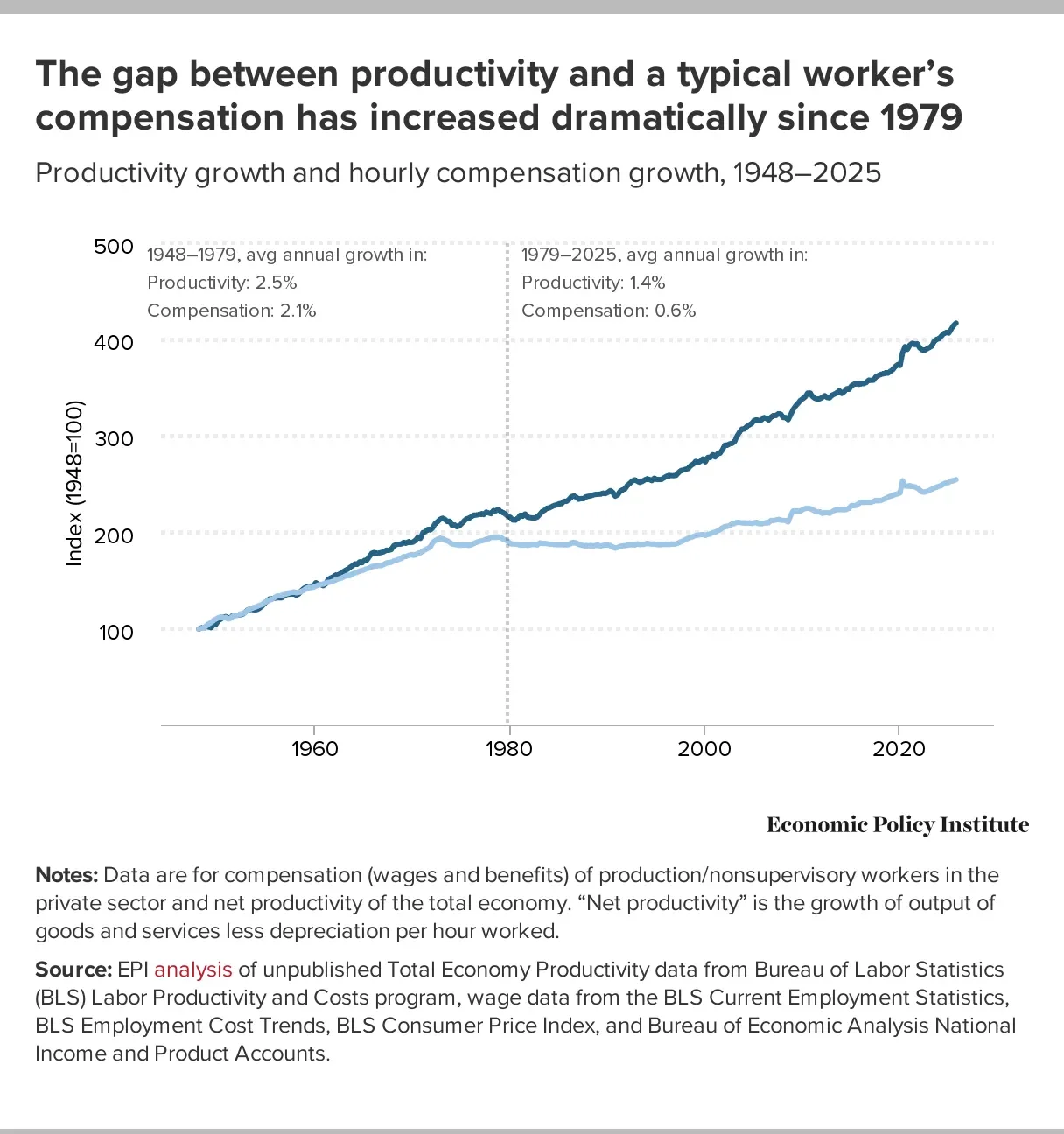
Figure 1: 47. Economic Policy Institute “The Productivity Pay Gap” March 23, 2026, https://www.epi.org/productivity-pay-gap/
Wage increases have persistently lagged behind inflation. As prices for housing, healthcare, childcare, and everyday goods have climbed, wages have not kept up, eroding purchasing power and deepening the cost-of-living crisis. Minimum wage rates have remained unchanged at the federal level since 2009. 46
As a result, millions of workers—especially Millennials and Gen Z—find themselves living paycheck to paycheck, unable to save or invest for the future. The gap between what workers contribute and what they receive in compensation has widened, undermining the traditional promise that hard work leads to upward mobility.
Policy debates continue to focus on the need for wage reform, including raising the minimum wage and strengthening collective bargaining rights. Yet, legislative action has been slow, and many states still adhere to the federal minimum, which has lost significant value due to inflation. 47 The consequences are felt most acutely by younger workers entering the labor market, who must navigate an environment of stagnant wages, unstable employment, and mounting debt. This reality underscores the structural challenges facing the current generation and highlights the urgent need for policies that restore the connection between productivity and pay.
Long-Term Financial Stability: Over the past several decades, the landscape of retirement security in the United States has undergone profound changes, leaving younger generations with heightened uncertainty about their financial futures. Social Security, once a bedrock of retirement income for Americans, now faces mounting challenges due to demographic shifts, rising life expectancy, and chronic underfunding. As the population ages and the ratio of workers to retirees declines, there are growing concerns that Social Security may not be able to provide the same level of benefits to future retirees as it did for previous generations. This uncertainty has prompted ongoing policy debates about the program’s sustainability and the need for reforms to ensure its long-term viability.48
Compounding these pressures is the widespread discontinuation of employer-sponsored pension programs. Traditional defined-benefit pensions, which guaranteed workers a steady income in retirement, have largely been replaced by defined-contribution plans like 401(k)s. While these plans offer greater flexibility, they shift the burden of saving and investment risk onto employees. Many workers now struggle to consistently contribute to their retirement accounts, especially in an environment of stagnant wages and rising living costs. The erosion of employer pensions has left millions without a reliable safety net, intensifying the anxiety surrounding retirement planning and financial security.48
Together, the challenges facing Social Security and the decline of employer pensions underscore a fundamental shift in the American social contract. 49 Younger generations must now navigate a retirement landscape that is far less predictable and far more dependent on individual responsibility. 50 This reality not only exacerbates economic inequality but also places additional stress on workers who must plan for their futures amidst uncertain income, unstable employment, and mounting debt. 51 Addressing these challenges will require thoughtful policy interventions and a renewed commitment to strengthening the pillars of retirement security.52
Cost of Living Crisis / Hyperinflation: Beyond the escalating costs of housing and rent, Americans are grappling with a pervasive cost of living crisis that touches nearly every aspect of daily life. The price of everyday necessities—groceries, gasoline, utilities, cable, and streaming services—has surged, straining household budgets and making it increasingly difficult for families to maintain their standard of living.
Gasoline: According to the U.S. Energy Information Administration, the national average price of regular gasoline rose from about $2.25 per gallon in 2020 to over $3.50 per gallon in 2024, with recent spikes pushing prices above $4.00 in many regions.53 These fluctuations have been driven by global supply chain disruptions, geopolitical tensions, and changes in crude oil production. The most recent surge in gas prices—prompted by conflicts in oil-producing regions and supply cuts—has hit younger Americans particularly hard. Many in Gen Z and Millennials, who often have lower incomes and less savings, are disproportionately affected, especially those relying on cars for work or school and lacking access to robust public transit systems.54
Groceries: The U.S. Department of Agriculture reported that food-at-home prices increased by 5.4% in 2023 compared to 2022, with staples like eggs surging by as much as 32% in early 2023 due to supply shortages and inflation.55 Bread, milk, and fresh produce have also seen consistent price hikes, leaving shoppers with fewer affordable options and contributing to widespread sticker shock at the supermarket.
Utilities: Utility bills have climbed steadily, with the Bureau of Labor Statistics noting a 10% increase in electricity costs from 2022 to 2024.56 Heating and water expenses have similarly risen, driven by higher energy prices and infrastructure costs. Internet and cable bills have not been immune: the average monthly cable bill in the U.S. reached $85 in 2024, up from $70 in 2020.57
Cable and Streaming Services: The cost of streaming subscriptions has also increased. Major platforms such as Netflix, Hulu, and Disney+ have raised prices multiple times, with Netflix’s standard plan rising from $13.99 per month in 2020 to $15.49 in 2024.58 Many Americans now juggle several subscriptions, which collectively strain household budgets and force difficult choices about entertainment and connectivity.
Across all these categories, rising costs are squeezing Americans—especially younger generations—who often lack the financial resources to absorb these increases. The convergence of higher prices for gasoline, groceries, utilities, and digital services is reshaping daily life, amplifying economic anxiety, and making it harder for many to make ends meet.
Transportation expenses, whether for car maintenance, insurance, or public transit fares, add another layer of financial pressure. According to the U.S. Bureau of Labor Statistics, transportation costs for households increased by over 15% from 2020 to 2024, while average hourly wages rose only about 12% during the same period.59 The average annual cost to own and operate a new car reached $12,182 in 2024, up from $10,728 in 2022—an increase of nearly 14%, driven by rising insurance premiums, fuel prices, and maintenance costs.60 Public transit fares have also seen steady hikes, with major cities reporting fare increases between 5% and 10% since 2021.3 For many, these cumulative increases outpace wage growth, leaving little room for savings or unexpected expenses. The result is a sense of economic insecurity that permeates daily decisions—from what to buy at the store to whether to postpone essential medical care. While policymakers debate causes and solutions, the lived reality for millions is one of constant adjustment and sacrifice, as they navigate an environment where the basics of modern life grow less affordable year after year.
Increasing Costs for Healthcare and Childcare: The rising costs of healthcare and childcare represent two of the most significant financial pressures facing American families today. Over the past decade, the average annual premium for family health insurance coverage purchased through employers has increased from about $13,375 in 2010 to over $22,463 in 2022—a rise of nearly 70%.62 Hospital costs have grown by 31% since 2012, and the average annual deductible for employer-sponsored health plans has increased 61% over the past ten years, reaching $1,763 in 2022.63 Prescription drug spending per capita has also climbed, with Americans paying an average of $1,432 annually out-of-pocket for medications.64 For many, even a single medical emergency can result in bills that threaten their financial stability. Americans are now spending more out-of-pocket on health insurance premiums, and the cost of prescription medications continues to climb, placing essential treatments out of reach for those without robust coverage. These escalating expenses force families to make difficult choices, often delaying care or skipping preventive services in order to manage their budgets.65
Childcare costs compound these challenges, particularly for working parents. The average annual cost of center-based childcare for an infant in the United States was $14,760 in 2022, with costs exceeding $20,000 in some states—surpassing the average cost of in-state college tuition.66 In 41 states and Washington, D.C., the cost of center-based infant care is higher than the average rent.67 Families must navigate long waitlists, high fees, and limited access to quality providers, all while juggling work responsibilities. For many households, the expense of childcare consumes a substantial portion of their income—often more than 20% for median-income families with young children—forcing parents, especially mothers, to reconsider their participation in the workforce or seek alternative arrangements.68 The cumulative effect of rising healthcare and childcare costs is a pervasive sense of economic insecurity, as families struggle to provide for their children’s well-being and their own health needs.69
Physical, Social, and Psychological Safety: Younger generations in America are navigating a landscape fraught with unprecedented social and safety challenges. The threat of gun violence is ever-present, with schools, public spaces, and communities often at risk of sudden tragedy. For example, according to the Centers for Disease Control and Prevention (CDC), firearm-related deaths among children and adolescents (ages 1–19) reached 4,733 in 2020, making guns the leading cause of death for this age group70. In 2022, there were 51 school shootings resulting in injuries or deaths—more than any year since tracking began71. This reality has shaped a generation that is acutely aware of the fragility of physical safety, as record levels of gun-related incidents have created a persistent atmosphere of anxiety and vigilance.
Alongside concerns about violence, the specter of climate change looms large. Youth are growing up amid climate instability—facing extreme weather events, wildfires, and rising sea levels—which not only threaten their environment but also their sense of security and hope for the future. According to the National Oceanic and Atmospheric Administration (NOAA), 2023 saw a record 28 billion-dollar weather and climate disasters in the U.S., including hurricanes, wildfires, and floods72. The American Psychological Association notes that climate anxiety is increasingly prevalent among young people, with 67% of surveyed youth expressing worry about climate change73. The urgency of climate action has become a defining issue, prompting many young people to advocate for systemic change and to reconsider decisions about where to live, how to work, and what to prioritize in their daily lives.
Political division further complicates the social environment. Polarization has deepened mistrust and fractured communities, making it harder for younger Americans to find common ground and meaningful dialogue. A 2022 Pew Research Center survey found that 79% of Americans believe the country is more divided than ever, and 61% of Gen Z respondents say political debates are increasingly uncivil74. This era of contentious politics, fueled by ideological rifts and policy stalemates, erodes social cohesion and leaves many feeling isolated or disillusioned with traditional avenues of civic engagement.
Digital misinformation adds another layer of complexity. Social media platforms, which have become central to how young people communicate and form their identities, are also vectors for false information and manipulative content. In 2021, a study by the Stanford History Education Group found that only 13% of high school students could accurately identify a credible source online75. Moreover, the Pew Research Center reported that 64% of Americans believe social media has a mostly negative effect on the way things are going in the country today, largely due to the spread of misinformation76. Navigating these spaces requires constant vigilance and discernment, as misinformation can undermine trust, distort perceptions, and exacerbate societal divides.
Taken together, these social and safety issues contribute to an elevated sense of ambient stress and uncertainty for younger generations. According to the American Psychological Association’s 2023 Stress in America report, 87% of Gen Z adults reported feeling stressed by the state of the nation, and nearly half said their mental health had worsened in the past year77. Their responses—to seek community, to advocate for change, or to retreat from public discourse—are shaped by a world fundamentally altered by decades of political, economic, and technological decisions that preceded their adulthood.
Loss of Trust : Over the past several decades, younger generations have experienced a pronounced decline in confidence in established institutions and traditional standards or beliefs.78 Multiple studies reveal that trust in government, media, educational systems, and even interpersonal relationships has steadily eroded among Millennials and Generation Z.79 According to a 2022 Pew Research Center survey, only 21% of Americans say they trust the government in Washington to do what is right “just about always” or “most of the time,” a figure that is even lower among adults under 30.80 Similarly, the 2023 Edelman Trust Barometer found that Generation Z expressed the least trust in business, media, and government compared to older cohorts.81 Over recent decades, American society has witnessed a profound erosion of trust in the institutions and individuals once considered the bedrock of stability—governments, corporations, the media, educators, and even family. This decline is not confined to abstract systems; it reaches into the daily lives of young people and adults alike, coloring how they perceive authority and interact with the world around them. Where earlier generations might have accepted the guidance of parents, teachers, or political leaders without question, today’s youth are far more likely to approach such figures with skepticism or outright distrust.82
The education system, once regarded as a reliable pathway to opportunity, has become a source of anxiety and contention. Students and families question whether schools and universities can deliver on their promises, as debates over curriculum, safety, and student debt dominate public discourse.83 Likewise, the media—historically trusted to provide objective information—now faces accusations of bias and sensationalism, fueling polarized perspectives and contributing to widespread confusion about what is true.84
Politicians and public officials, who are supposed to represent the interests of their constituents, are increasingly seen as self-interested or disconnected from the realities faced by ordinary citizens. Scandals, gridlock, and partisan conflict have left many voters feeling alienated and powerless, uncertain that their voices will be heard or their concerns addressed.85 Even within families, generational divides over social values and digital culture can undermine the sense of cohesion that once seemed unshakeable.86
As a result, many individuals have retreated from traditional sources of authority, seeking community and validation in alternative spaces—often online or within tightly knit social groups.87 This widespread decline in institutional trust shapes not only how people engage with the world, but also how they imagine their futures, make decisions, and relate to one another. The consequences are visible in diminished civic participation, increased polarization, and a pervasive sense of uncertainty about whom or what can be believed.88
Navigating a Changing Landscape: Generational Responses to Modern Challenges
These economic pressures are compounded by broader social realities. Younger generations have come of age in a society marked by record levels of gun violence, climate instability, political polarization, and the pervasive influence of social media—platforms that older generations allowed to grow unchecked and that now shape young people’s sense of identity, safety, and belonging. These conditions create a level of ambient stress and uncertainty that older generations did not experience at the same scale.
Taken together, these structural realities form the backdrop against which younger generations are making decisions about work, family, community, and civic engagement. Their choices are not evidence of apathy; they are evidence of adaptation. They are responding to a world fundamentally altered by decades of economic, political, and cultural decisions made long before they reached adulthood.
V. The Irony: Older Generations Criticize Outcomes They Created
The social, economic, and political landscape of modern America has undergone profound shifts, reshaping the experiences and outlooks of younger generations. As they navigate unprecedented challenges ranging from institutional mistrust to rising economic pressures, their responses and choices reflect a world fundamentally transformed by decisions and events predating their adulthood. Understanding these generational dynamics is essential to bridging divides and fostering meaningful dialogue about the future.
The Disconnect Between Expectations and Reality: Older generations often measure success and stability by benchmarks that were attainable in their youth: affordable education, secure employment, accessible homeownership, and trusted institutions. They expect younger generations to follow similar life trajectories; however, the reality confronting today’s youth is starkly different. Decades of rising tuition, stagnant wages, climbing housing costs, and eroding trust in institutions have reshaped the landscape, making these traditional markers of adulthood far more difficult to achieve.
While older generations may view young people’s choices—living with parents longer, delaying marriage, or questioning authority—as signs of apathy or lack of ambition, these behaviors more accurately reflect adaptation to new realities. As indicated in previous chapters, the burden of student debt and high housing prices have made financial independence and homeownership less attainable for many, despite hard work and prudent decisions. Likewise, the breakdown of institutional trust means that younger generations are less likely to accept established norms and more inclined to seek alternative communities and information sources.
The disconnect between expectations and reality fuels intergenerational misunderstandings. Whereas older adults may lament what they see as the erosion of values or civic engagement, younger people are navigating a world fundamentally changed by the political, economic, and technological choices of previous decades. Their responses—whether to advocate for change, find new forms of connection, or retreat from traditional structures—are shaped by the conditions they have inherited, not by a lack of will or effort.
The Refusal to Acknowledge Generational Advantage: Despite the profound changes in economic and social realities over the past several decades, many older adults struggle to recognize the unique advantages they held when coming of age. These generations often assume that their own markers of achievement—such as affordable college tuition, stable career paths, and attainable homeownership—are simply the result of personal effort and prudent decision-making, rather than the product of a particular historical moment. This perspective overlooks the structural benefits they enjoyed: lower costs of living, robust social safety nets, and a higher degree of trust in institutions that provided a sense of security and predictability.
By framing their success in terms of individual merit, older generations minimize the systemic barriers now facing young people. This refusal to recognize generational advantage perpetuates misunderstandings and places the burden of adjustment solely on those navigating a world transformed by decisions made long before they reached adulthood. It obscures the reality that younger people’s strategies are not merely personal choices but responses to a set of challenges inherited from the very systems and policies that benefited their older predecessors
Ultimately the inability or unwillingness to confront these generational disparities hinders constructive dialogue and empathy between age groups.
Misattributed Blame: Throughout recent decades, a recurring narrative has emerged in which older generations attribute the challenges faced by younger people to individual shortcomings rather than the broader systemic shifts that occurred during their own era. This tendency to assign blame, instead of acknowledging the structural changes and policy decisions that shaped the current landscape, obscures the true origins of today’s difficulties and perpetuates intergenerational misunderstandings.
Older adults often hold fast to the belief that success stems from personal effort, discipline, and prudent choices. They may dismiss adaptive behaviors—like living with parents longer, delaying marriage, or seeking alternative sources of community—as failures to live up to traditional standards. In doing so, they ignore how these choices are shaped by inherited conditions and systemic barriers, not simply by individual will or resolve.
The refusal to recognize generational advantage and the impact of historical context further entrenches this attribution of responsibility. By framing their own achievements as the result of merit alone, older generations minimize the structural benefits they enjoyed, such as affordable college tuition and robust social safety nets. This selective memory distorts the conversation, making it harder to engage in constructive dialogue and mutual understanding across age groups and which hinder our ability to craft meaningful solutions to the problems facing younger generations. Acknowledging the historical roots of their challenges and the role of past decisions is essential for fostering intergenerational cooperation and creating a more equitable society.
The Psychological Need to Preserve the Myth of Meritocracy: The enduring belief in meritocracy—the idea that success is determined solely by individual talent, hard work, and determination—serves a powerful psychological function for older generations. As the preceding sections have shown, many older adults frame their achievements in terms of personal merit, emphasizing discipline and prudent choices while often overlooking the unique historical circumstances and structural advantages that shaped their opportunities. Adhering to the narrative of meritocracy allows them to maintain a sense of earned accomplishment and self-worth, validating their life choices and reinforcing their identity as self-made individuals.
This psychological need to uphold the myth of meritocracy also helps shield older generations from confronting uncomfortable truths about the changing social and economic landscape. Acknowledging that their success was facilitated by affordable education, stable career paths, and accessible homeownership would require recognizing the role of favorable policies, robust social safety nets, and greater institutional trust—factors largely outside individual control. For many, accepting that younger generations now face structural barriers that did not exist in the past challenges the notion that personal effort alone is sufficient for upward mobility.
Consequently, the myth of meritocracy perpetuates generational misunderstandings. It enables older adults to attribute the struggles of today’s youth to a lack of ambition or work ethic, rather than acknowledging the profound shifts in economic conditions, rising costs, and diminished opportunities. By clinging to this narrative, they may resist calls for systemic change or policies aimed at addressing current inequities, further entrenching the divide between generations.
Ultimately, only by critically examining the limits of meritocracy and recognizing the influence of historical context can society foster genuine empathy and dialogue across age groups. Letting go of the myth does not diminish individual achievements; rather, it opens the door to a more honest and constructive conversation about the challenges facing younger generations and the collective responsibility to build a more equitable future.
VI. The Myth of Millennial and Gen Z “Apathy” -Why Younger Generations Are Opting Out
Younger generations’ choices—such as living with parents longer, delaying marriage, or seeking new forms of community—are logical adaptations to the economic and social realities they have inherited. These decisions are shaped by rising costs, stagnant wages, and weakened trust in institutions, not a lack of ambition or moral resolve. Rather than viewing these behaviors as failures, it’s crucial to recognize them as thoughtful responses to structural challenges that demand practical solutions and empathy.
Delayed Marriage and Parenthood: In recent decades, younger generations have increasingly postponed marriage and parenthood—choices that reflect pragmatic responses to shifting economic and social realities rather than failures of ambition or moral resolve. The decision to delay these milestones is shaped by a confluence of factors, including rising educational costs, stagnant wages, soaring housing prices, and diminishing trust in institutions. These structural barriers have made it more difficult for young adults to achieve financial stability and independence, leading many to prioritize economic security before committing to long-term partnerships or starting families.
Historically, earlier generations benefited from affordable college tuition, robust job markets, and accessible homeownership, which made early marriage and parenthood more attainable.89 However, as policies shifted toward deregulation and market-driven solutions in the late twentieth century, opportunities for stable employment and affordable housing have declined.90 The resulting economic uncertainty has prompted younger adults to adapt by living with parents longer, pursuing advanced education, or seeking alternative forms of community, often delaying traditional milestones such as marriage and raising children. 91
By viewing delayed marriage and parenthood through the lens of inherited conditions and systemic challenges, it becomes clear that these behaviors are not simply personal choices, but logical adaptations to a landscape where traditional pathways to adulthood have become less accessible. 92 Recognizing this context is essential for fostering empathy and understanding across generations, and for developing practical solutions to address the root causes of these delays. 93
Mobility as a Survival Approach in a Precarious Employment Market: In response to an increasingly unstable job market—characterized by fewer stable, long-term positions, rising costs of living, and diminished institutional support—many younger adults have embraced mobility as a key survival strategy. Rather than expecting to build lifelong careers with a single employer, younger generations are more likely to switch jobs, relocate for better opportunities, or pursue gig and freelance work. This adaptive approach allows them to seek out higher wages, improved benefits, or more meaningful work in an environment where traditional paths to stability and advancement have become less reliable.94
By remaining flexible and open to change, younger workers are better equipped to navigate the uncertainties of the modern economy. Here lies an irony: the job market’s instability—marked by fewer secure positions and less institutional support—was largely shaped by shifts and decisions made by older generations. Yet, despite having created these conditions, older generations often criticize younger workers for lacking commitment to long-term employment. The mobility younger people have adopted is not simply a matter of preference, but a practical response to the realities left behind by their predecessors. This emphasis on adaptability and resilience is essential for long-term security and success, even as it is sometimes misunderstood or disparaged by those who benefited from more stable opportunities.95,96
VII. The Hard Truths: Older Generations Cannot Lead on This Issue
While older generations may empathize with the challenges facing today’s youth, the reality is that the roots of these issues are deep and systemic. No single generation can reverse decades of economic, social, and policy changes on their own. Instead, progress requires broad acknowledgment of these hard truths and collaborative efforts across age groups to forge lasting solutions. This section explores why the hurdles confronting younger generations cannot be simply “fixed” by their predecessors, and why understanding, rather than blame, is essential to moving forward together.
Lack of Self-Awareness and Recognition: A widespread failure to acknowledge and understand the systemic forces shaping generational differences makes it harder to bridge the divide between age groups. When individuals and institutions do not recognize the deeper economic and social factors at play, it becomes difficult to foster empathy, address misconceptions, or pursue meaningful solutions. This absence of self-awareness perpetuates misunderstanding and stalls progress toward healing and across generations.
Instinct to Preserve Established Systems: Older generations, having benefited from the established economic, social, and policy frameworks of their formative years, often display a strong instinct to maintain these systems rather than overhaul them. This preservationist impulse is not merely a matter of personal comfort or nostalgia—it is deeply rooted in the structures that once provided stability, opportunity, and upward mobility. For many, the pathways to success were paved by affordable education, accessible homeownership, and reliable employment, all undergirded by policies and institutions tailored to their needs and historical context.
As a result, when proposals arise that challenge or seek to revise these systems—such as student loan forgiveness, universal healthcare, or flexible work arrangements—older generations may be hesitant or even resistant. Their reluctance is often reinforced by the perception that such changes threaten the legitimacy of the meritocratic ideals and personal sacrifices that defined their own experiences. Moreover, some have financial or political incentives tied to the preservation of the status quo, whether through property ownership, pension structures, or established workplace norms.
This instinct to safeguard existing systems, even when those systems no longer serve younger generations, creates a significant barrier to reconciliation and progress. Policies that might offer relief or opportunity to today’s youth—such as canceling student debt, expanding healthcare access, or normalizing remote work—are frequently dismissed as impractical, unfair, or disruptive to established order. In doing so, older generations perpetuate the very inequalities and obstacles that make it difficult for younger people to achieve the same milestones once taken for granted.
True reconciliation and meaningful reform require not only empathy but also a willingness to critically examine and, when necessary, relinquish the systems that have outlived their equity or effectiveness. Without this structural self-awareness and openness to change, older generations are limited in their ability to lead on issues that demand bold, forward-looking solutions—especially when those solutions may challenge their long-held assumptions or material interests.
Making for Emerging Leadership: In business, politics, civic organizations, and religious institutions, leadership roles have historically—and continue to be—dominated by older generations. Overrepresentation of older generations can unintentionally stifle innovation and hinder organizational responsiveness to new challenges. Ultimately, this diminishes operational resilience. When older leaders step aside, it is not a sign of disrespect or disregard for their experience and contributions. Instead, it is a necessary and thoughtful action that creates space for younger leaders to bring forward fresh perspectives, new strategies, and innovative ideas—qualities essential for progress in a changing world.
It is vital that organizations and communities pivot effectively toward solutions that address contemporary realities. Younger generations possess unique insights shaped by current economic, technological, and social landscapes. By allowing them to lead and influence decision-making, institutions can better reflect the needs and aspirations of today’s society. It is through this intentional transition that we build bridges across generations, foster mutual respect, and ensure the sustainability and relevance of our organizations for the future.
Ultimately, stepping aside does not diminish legacy; it empowers the next generation to advance, ensuring continued growth. Welcoming their leadership is a practical, forward-looking step that strengthens our collective capacity to meet new challenges, adapt to evolving circumstances, and drive meaningful change.
VIII. Why Boomers Should Care
Older generations, especially Boomers, have a vested interest in caring about the challenges facing today’s youth—not only because these issues affect the fabric of society, but also because the solutions require their insight, influence, and willingness to adapt. As the architects and beneficiaries of longstanding social, economic, and policy systems, they play a pivotal role in shaping whether those systems continue to support opportunity and stability for all. By recognizing the struggles of younger generations and engaging constructively in the conversation, Boomers help foster empathy, bridge generational divides, and ensure that progress benefits both current and future members of society. Ultimately, their participation is essential for creating lasting reforms and maintaining the health and sustainability of the communities, institutions, and legacies they helped build.
Social Cohesion: Generational resentment poses a significant threat to democracy, civic order, and the sense of community. Divisions between age groups erode trust and cooperation across society, making it harder to reach consensus and work collectively toward common goals. This in turn can fuel polarization, weaken democratic institutions, and reduce civic participation. The resulting mistrust undermines efforts to solve shared challenges, from economic stability to leadership succession. By fostering empathy and understanding between generations, communities can strengthen social cohesion, promote healthier civic engagement, and ensure the resilience of democratic systems for the future.
Succession Crisis: As older generations continue to dominate leadership roles in businesses, institutions, and civic organizations, a growing succession crisis looms on the horizon. Without intentional efforts to welcome and empower younger leaders, these organizations risk facing a leadership vacuum when the current generation steps aside or retires. The reluctance to transition authority means that new ideas and strategies are stifled, and the pipeline for future leaders grows increasingly thin.
In business, the lack of succession planning threatens the continuity of operations and diminishes competitiveness. Civic organizations lose relevance without leaders who understand and address the evolving needs of their communities. Religious institutions, too, may struggle to remain vibrant if younger members are not engaged and entrusted with leadership. If younger generations are not provided meaningful leadership roles and development opportunities, many organizations will simply have no one ready—or willing—to take the reins. This absence of prepared successors can lead to instability, stagnation, and even dissolution. The legacy and sustainability of these entities depend on a smooth transfer of responsibility that embraces fresh perspectives and adapts to contemporary challenges. Ultimately, ensuring a robust succession plan is not just about preserving tradition—it is about ensuring the future and vitality of organizations that serve society overall.
Economic Stability: The financial insecurity facing younger generations poses a significant risk to the overall stability of the economy, including retirees whose well-being depends on a robust economic foundation. As younger adults struggle with stagnant wages, high housing costs, and mounting student debt, their ability to participate fully in the economy—by purchasing homes, investing, and supporting businesses—has diminished. When younger people face financial precarity, the effects reverberate throughout society. Their reduced economic activity undermines the systems that provide for retirees, such as pensions and Social Security. If fewer workers contribute to these safety nets, or if the economy falters due to insufficient consumer demand, retirees may jeopardize their own financial security and well-being. In essence, the prosperity of all generations is interconnected.
Practical Realities: As Boomers grow older, their well-being will increasingly depend on the younger generations who provide essential care, services, and economic support. From healthcare professionals and social workers to those who sustain public infrastructure and local businesses, younger adults will be responsible for much of the day-to-day assistance and specialized services needed by an aging population. Moreover, the economic vitality that underpins retirement security relies on the continued participation and productivity of younger workers. Recognizing this interdependence is crucial: addressing the social, emotional, educational, and financial issues of younger generations ensures that older adults will have access to quality care and a stable economic foundation as they age. This mutual reliance underscores the importance of strengthening intergenerational relationships so that both can thrive together in a changing society.
Legacy: The legacy left by older generations is shaped not only by the institutions they built, but also by their ability to preserve these entities for future generations. The question is whether they will pass on a robust, functioning society—one where businesses, civic organizations, and religious institutions remain vibrant and relevant—or a hollowed-out structure, weakened by a lack of emerging leaders. By actively nurturing and empowering younger leaders, older generations preserve and strengthen their life’s work and support its enduring impact. Conversely, failing to foster new leadership risks losing the hard-won gains of decades, stagnation, or even collapse. The true measure of legacy, then, is found in the ability to create pathways for succession and renewal, so that the entities existing today will stand strong tomorrow, guided by the fresh vision and energy of those ready to take up the mantle.
IX. The Future Depends on Younger Generations
As we look ahead, it becomes increasingly clear that the trajectory of society, its institutions, and its collective well-being will be determined by the choices and contributions of younger generations. The challenges we face—whether economic, social, or organizational—are evolving rapidly, and the solutions require fresh perspectives, adaptability, and a willingness to embrace change. Transitioning leadership and responsibility is not just an affirmation of faith in the next generation’s capacity to innovate, steward, and sustain the legacy built by those who came before but an act of necessity.
Welcoming Millennials and Generation Z as the Next Generation of Leaders: As society stands at a crossroads, it is clear that Millennials and Generation Z must take up the mantle to rebuild and renew the institutions, communities, and systems that shape our collective lives. The challenges ahead are evolving faster than ever, and the world’s future now hinges on the energy, creativity, and adaptability of its younger members. It is not simply an option for Millennials and Gen Z to step forward; it is a necessity.
Only by entrusting Millennials and Generation Z with meaningful roles can we ensure a orderly succession transition and support the institutions and systems that make up a healthy society. Their unique perspectives and willingness to embrace change are essential for confronting contemporary challenges and forging solutions that will endure.
Moreover, the interconnectedness of economic stability and social well-being means that the prosperity of all generations depends on younger adults’ ability to thrive. Struggles with stagnant wages, high living costs, and financial insecurity have inhibited youth’s full participation in the economy. Nevertheless, youth’s full economic participation is crucial not just for their own futures but for the Silent and Baby Boomer generations, which are increasingly dependent on safety nets and social services. The mutual reliance between generations underscores why the younger generations must rebuild.
Ultimately, the legacy of older generations will be measured not only by what they built, but by how they empowered those who follow. If Millennials and Gen Z are welcomed as leaders, society will remain vibrant and relevant, guided by fresh vision and renewed purpose. The responsibility to rebuild rests with them because the world they inherit is theirs to sustain, transform, and pass forward. The future depends on their courage, innovation, and determination to shape a society that works for all, now and for generations to come.
Establishing the New Means Rejecting the Old: The establishment of a new social contract starts with rejecting outdated norms. For many older adults, the prospect of younger generations rejecting long-standing norms and traditions stirs deep psychological fears. Passing the torch is rarely just about changing policies or procedures: it often feels intensely personal. When younger people challenge or discard the frameworks that guided their predecessors, older generations may interpret this as a repudiation not only of the systems they built but of their own values, identities, and life’s work. This emotional response is rooted in the natural human desire for legacy and validation – to see one’s way of doing things replaced can feel like rejection, erasure, or irrelevancy. The rejection of outdated norms can seem like a rejection of the people who upheld them, making the transition fraught with emotion and resistance.
The anxiety that comes with relinquishing power is compounded by uncertainty about the future. Older generations may worry that, in rejecting what came before, the younger will overlook hard-won lessons and repeat past mistakes. This fear is about the continuity of meaning and the hope that one’s contributions will endure.
Navigating this delicate terrain requires honesty and empathy from all sides. Younger generations must exercise humility and honor the emotional stakes involved for their elders, especially as they push for necessary change. Likewise, older generations must set aside ego and exercise vulnerability. This would enable older generations to separate critique of the past from condemnation of their personhood, allowing them to foster the evolution of society by nurturing new leaders. Only by openly addressing these fears and insecurities can we build a truly inclusive and forward-looking social contract — one that acknowledges the value of what came before, while making room for what must come next.
Toward a Fairer, Sustainable, and Realistic Society: The transition of leadership from older to younger generations offers a unique opportunity to advance a society that is more just, sustainable, and grounded in the realities of the present and future. Millennials and Generation Z are assuming leadership roles at a time marked by rapid technological change, shifting economic landscapes, and urgent environmental concerns. Their lived experiences have shaped a worldview that prioritizes equity — the need to address systemic inequalities and ensure equal opportunity for all. Compared to previous eras, these younger leaders are more likely to advocate for inclusive policies, champion social justice, and question traditions that no longer serve the collective good.
Sustainability stands at the forefront of their agenda. Raised amid climate crises and resource scarcity, younger generations bring a practical urgency to environmental stewardship. Their leadership is defined by a willingness to innovate and adopt new approaches, whether through supporting renewable energy, reimagining consumption, or demanding corporate transparency and accountability. This focus is not simply ideological but rooted in the necessity to secure a livable planet for themselves and generations to follow.
Grounded in realism, Millennials and Gen Z are acutely aware of the challenges they inherit: stagnant wages, rising living costs, and the fragility of social safety nets. Rather than clinging to outdated norms, they seek solutions that reflect current realities and anticipate future needs. This pragmatic mindset is crucial for rebuilding institutions, fostering economic stability, and strengthening the social contract between generations. As they take on leadership roles, their adaptability and forward-thinking vision support creation of systems that are resilient, responsive, and relevant.
Ultimately, the pivot to younger leadership is not merely a generational shift—it is a catalyst for meaningful change. By welcoming the courage, creativity, and determination of Millennials and Gen Z, society moves closer to realizing a fairer, more sustainable, and reality-based future. The legacy of older generations is honored not by preservation but by empowering those who follow to build, transform, and carry forward the values that matter most.
X. Conclusion: A Call for Intergenerational Honesty and Courage
As society stands at a crossroads between tradition and transformation, the need for honest dialogue and mutual bravery across generations has never been more vital. The challenges confronting Millennials and Gen Z are not isolated burdens but consequences of choices made over decades. When younger generations voice dissatisfaction or push for change, they are highlighting systemic problems with our society. Younger people are a warning system signaling an unsustainable status quo and urgent need for transformation.
Younger Generations Are a Warning, Not the Problem: Too often, public discourse frames Millennials and Generation Z as the source of society’s challenges—accusing them of impatience, entitlement, or a lack of resilience. Yet, this view fails to recognize that younger generations are not the architects of the world they inherit. The economic instability, climate crisis, and social inequities that Millennials and Gen Z confront did not arise in a vacuum. These realities are the result of decades of policy decisions, cultural shifts, and institutional priorities set by those in power. Their actions and attitudes reveal the cumulative effects of deferred responsibility, unsolved problems, and unaddressed injustices. The struggles of the young should not be viewed as indictments of their character but echoes of a legacy handed down—intentionally or not—by their predecessors. Their priorities, demands, and even their defiance are, in many ways, a direct response to the realities and values modeled by those who came before. Thus, the anxieties, frustrations, and demands expressed by younger people act as a mirror showing the world older generations shaped, which reflect cracks in the social contract and expose systems that no longer serve the common good.
Addressing these realities requires both younger and older adults to face uncomfortable truths, honor each other’s experiences, and move forward with humility and resolve. If we wish to understand the present and build a better future, we should not scorn the messenger. Instead, we must listen to our youth without condescension or defensiveness and take accountability for the world that has been created. Only through candid conversation and a willingness to learn from one another can we forge a future that is equitable, sustainable, and rooted in collective wisdom.
Truth-telling, humility, and accountability: Truth-telling, humility, and accountability form the foundation of authentic trust between generations. Trust is not simply granted—it is earned through honest communication about the realities facing society, including both achievements and failures. When older and younger generations are willing to speak candidly about their experiences, choices, and mistakes, it paves the way for understanding and cooperation. Truth-telling allows each generation to see the world as it truly is, rather than through the lens of blame or denial. By acknowledging past decisions and their consequences, both groups can confront uncomfortable truths and begin to heal divides deepened by misunderstanding or avoidance.
Humility is equally essential, reminding all generations that no group possesses a monopoly on wisdom or virtue. It encourages openness to learn from one another, recognizing that every age cohort brings unique perspectives, strengths, and blind spots. Humility tempers pride and defensiveness, fostering empathy and a willingness to adapt. This quality is vital for bridging generational gaps, as it allows individuals to honor each other’s experiences without dismissing or diminishing them.
Accountability, meanwhile, ensures that trust is sustained over time. It compels each generation to own their role in shaping society—accepting responsibility for the outcomes of their actions and the environment they leave behind. Through accountability, promises are kept, wrongs are addressed, and the social contract is strengthened. Without it, trust becomes fragile and easily broken. When all parties commit to accountability, they demonstrate respect for one another and a shared investment in building a future that is more equitable, sustainable, and resilient.
Together – truth-telling, humility, and accountability create the conditions for honest dialogue, mutual respect, and shared progress. They are not just abstract ideals but practical tools for forging meaningful connections across generational lines. By embracing these tenets, society can move beyond division and distrust, and toward a reality where each generation feels valued, heard, and empowered to contribute to the collective good.
Moving Forward: Essential Actions for Resolving Intergenerational Conflict: To address the deep-rooted divisions and challenges that define our current era, it is imperative for older generations to take a series of intentional steps grounded in humility and a genuine commitment to progress. First, they must listen openly and attentively to the voices of younger generations. This means not only hearing their frustrations, hopes, and critiques but seeking to truly understand the lived realities that shape their perspectives. Such listening requires setting aside defensiveness and preconceived notions in favor of empathy and active engagement.
Second, older generations must recognize the role their actions—and, in many cases, inactions—have played in shaping the world as it is today. The policies enacted, priorities chosen, and problems left unaddressed over past decades have directly influenced the economic, social, and environmental realities Millennials and Gen Z now confront. Honest self-reflection and acknowledgment of this legacy are vital for building trust and creating a foundation for genuine reconciliation.
Third, it is essential for older leaders to step aside, making space for fresh perspectives and approaches. This does not mean abandoning their experience or wisdom, but rather understanding that renewal often requires relinquishing control and allowing new leadership to emerge. By stepping aside, older generations demonstrate faith in their succession management efforts as well as the capabilities of those who will shape the future. Moreover, stepping aside allows younger generations to engage directly with the cultural practices and policy changes that have contributed to the generational divide. This opportunity is crucial, as it empowers new leaders to address inherited challenges and to reimagine solutions in ways that foster greater unity and progress. By giving younger voices the space to lead, society enables them to build solutions grounded in their lived realities, ensuring that lessons from the past inform a more equitable and sustainable future.
Finally, ongoing support of new leadership is crucial. This involves not only passing the baton but also offering guidance, resources, and encouragement to those stepping into positions of influence and responsibility. Older generations can become allies and mentors, helping to smooth the transition and ensuring that hard-earned lessons from the past inform the path forward. By embracing these actions—listening, recognizing responsibility, stepping aside, and supporting new leadership—older generations can help bridge the divide and contribute to a legacy of cooperation, growth, and shared progress.
Dr. Lawrence Anderson is an African American author, strategist, political scientist, artist, technologist, and transformational leader whose work bridges political critique, cultural commentary, and visionary leadership. His lastest book The Synthetic Empire: The Rise of Corporate Rule, the Fall of Democracy, and the Path to Reclaim Our Future is available on all platforms in paperback, e-book and audio formats.
-
1. Tom Wolfe, “The ‘Me’ Decade and the Third Great Awakening,” New York Magazine, August 23, 1976
2. Lendol Calder, Financing the American Dream: A Cultural History of Consumer Credit (Princeton University Press, 1999).
3. Kim Phillips-Fein, Invisible Hands: The Businessmen’s Crusade Against the New Deal (W. W. Norton, 2009);
4. David Harvey, A Brief History of Neoliberalism (Oxford University Press, 2005).
4. Paul Krugman, The Conscience of a Liberal (W. W. Norton, 2007).
5. Pew Research Center, “The Rising Cost of Not Going to College,” 2014.
6. Depository Institutions Deregulation and Monetary Control Act of 1980, Pub.L. 96–221
7. David A. Moss, “An Ounce of Prevention: Financial Regulation, Moral Hazard, and the End of ‘Too Big to Fail,’” Harvard Magazine, 2009.
8. Gramm-Leach-Bliley Act of 1999, Pub.L. 106–102; Alan S. Blinder, “After the Music Stopped: The Financial Crisis, the Response, and the Work Ahead,” Penguin, 2013.
9. Financial Institutions Reform, Recovery, and Enforcement Act of 1989, Pub.L. 101–73; Adam J. Levitin & Susan M. Wachter, “Explaining the Housing Bubble,” Georgetown Law Journal, 2013.
10. Jake Rosenfeld, “What Unions No Longer Do,” Harvard University Press, 2014; David Weil, “The Fissured Workplace,” Harvard University Press, 2014.
11. Economic Recovery Tax Act of 1981, Public Law 97-34; Congressional Budget Office, “Historical Effective Federal Tax Rates: 1979 to 2005.”
12. Tax Policy Center, “History of Federal Income Tax Rates”; Congressional Research Service, “The Bush Tax Cuts and the Economy.”
13. Tax Cuts and Jobs Act of 2017, Public Law 115-97; Congressional Budget Office, “The Budgetary Effects of the Tax Cuts and Jobs Act.”
14. Congressional Budget Office, “Distributional Effects of the Tax Cuts and Jobs Act,” CBO Report, 2018.
15. Committee on Ways and Means, “Summary of the Big Beautiful Bill,” Legislative Report, 2025.
16. Center on Budget and Policy Priorities, “Analysis of Tax Policy Trends, 2017–2025,” Policy Brief, 2026.
17. U.S. Department of Health and Human Services, “Head Start Program Facts,” various years; Zigler, E., & Styfco, S. J. (2010). The Hidden History of Head Start. Oxford University Press.
18. Ravitch, D. (2013). Reign of Error: The Hoax of the Privatization Movement and the Danger to America’s Public Schools. Knopf.
19. U.S. Department of Agriculture, “National School Lunch Program: Background and Development,” Congressional Research Service Report R46234, 2023.
19. Kaiser Family Foundation, “Medicaid Financing: The Basics,” 2022;
20. Grogan, C. M., & Patashnik, E. M. (2003). Between Welfare Medicine and Mainstream Entitlement. Journal of Health Politics, Policy and Law, 28(5).
21. Rosenbaum, S. (2002). Medicaid Managed Care: Costs, Access, and Quality of Care. The Commonwealth Fund.
22. Jacobson, G., Freed, M., Damico, A., & Neuman, T. (2022). A Dozen Facts About Medicare Advantage in 2022. Kaiser Family Foundation.
23. Congressional Budget Office, “Federal Investment,” June 2018
24. American Society of Civil Engineers, “2021 Report Card for America’s Infrastructure.”
25. U.S. Department of Agriculture, “WIC Program: Background, Trends, and Issues,” Economic Research Service Report, 202
26. Gundersen, C., Kreider, B., & Pepper, J. (2011). The Economics of Food Insecurity in the United States. Applied Economic Perspectives and Policy, 33(3).
27. Public Works Financing, “U.S. Infrastructure Privatization,” 2021; Sclar, E. (2001). You Don’t Always Get What You Pay For: The Economics of Privatization. Cornell University Press.
28. U.S. Department of Health and Human Services, “Welfare Indicators and Risk Factors Annual Report,” 2022;
29. Victor, D. G., & Eskeland, G. S. (2012). Global Warming Gridlock. Cambridge University Press.
30. Shear, M. D. (2017, June 1). “Trump Will Withdraw U.S. From Paris Climate Agreement.” The New York Times.
31. Davenport, C. (2017, March 28). “Trump Signs Executive Order Unwinding Obama Climate Policies.” The New York Times.
32. Plumer, B., & Friedman, L. (2019, June 19). “Trump Administration Finalizes Its Plan to Replace Obama-Era Climate Rules.” The New York Times.
33. National Commission on the BP Deepwater Horizon Oil Spill and Offshore Drilling. (2011). Deep Water: The Gulf Oil Disaster and the Future of Offshore Drilling. Official Report.
34. U.S. Congressional Research Service. (2021). “The Renewable Electricity Production Tax Credit: In Brief.” Report R43453.
35. U.S. Global Change Research Program. (2018). “Fourth National Climate Assessment, Volume II: Impacts, Risks, and Adaptation in the United States.” [URL]>
36. Katz, L. F., & Krueger, A. B. (2016). “The Rise and Nature of Alternative Work Arrangements in the United States,” NBER Working Paper 22667.
37. Pew Research Center (2021). “Gig Workers and the Gig Economy.”
38. U.S. Bureau of Labor Statistics (2018). “Contingent and Alternative Employment Arrangements.”
39. National Association of Realtors. (2023). 2023 Home Buyers and Sellers Generational Trends Report.
40. Pew Research Center. (2023). More U.S. households are renting than at any point in 50 years.
41. Kaiser Family Foundation (2023). “Health Insurance Coverage and Costs: Trends and Challenges.”
41. College Board. (2023). Trends in Student Aid.
42. U.S. Supreme Court. (2023). Biden v. Nebraska.
43. U.S. Congress. (2005). Bankruptcy Abuse Prevention and Consumer Protection Act.
44. Federal Reserve. (2023). Report on the Economic Well-Being of U.S. Households.
45. Economic Policy Institute “The Productivity Pay Gap” March 23, 2026, https://www.epi.org/productivity-pay-gap/
46. U.S. Troop Readiness, Veterans’ Care, Katrina Recovery, and Iraq Accountability Appropriations Act, 2007, Public Law 110-28, 110th Congress, Congressional Budget Office
47. Brookings Institution. (2024). Gen Z Debt and Policy Implications.
48. “Gen Z & Millennials: The Cost of Living Crisis,” Deloitte Global Millennial and Gen Z Survey 2023.
49. U.S. Department of Labor. “Private Pension Plan Bulletin: Abstract of 2023 Form 5500 Annual Reports.” Accessed 04/10/2026.
50. Munnell, Alicia H., et al. “The Shift from Defined Benefit to Defined Contribution Plans: Implications for Retirement Security.” Center for Retirement Research at Boston College, 2024.
51 Pew Research Center. “Retirement Savings and Financial Security Among American Workers.” 2025.
52 Employee Benefit Research Institute. “2025 Retirement Confidence Survey.” 2025.
53. U.S. Energy Information Administration, “Weekly Retail Gasoline Prices.” https://www.eia.gov/dnav/pet/pet_pri_gnd_dcus_nus_w.htm
54. USA Today, “Outrageous Rising Gas Prices Are Changes the Way American Live” https://www.usatoday.com/story/news/nation/2026/04/01/gas-prices-4-changing-life-usa/89401740007/
55. U.S. Department of Agriculture, Electronic Research Service, “Food Price Outlook, 2023 and 2024.” https://www.ers.usda.gov/data-products/food-price-outlook
56. Bureau of Labor Statistics, “Consumer Price Index – Utilities.” https://www.bls.gov/cpi/
57. Wheelright, Trevor, “The State of TV 2026: Streaming Is King, but Cable Wants Its Crown Back”. https://www.cabletv.com/news/state-of-tv-report-2026
58. The Verge, “Netflix Is Raising Prices Again.” https://www.theverge.com/streaming/901833/netflix-subscription-pricing-increase-2026.
59. U.S. Bureau of Labor Statistics, Consumer Expenditure Survey 2020–2024. https://www.bls.gov/news.release/cesan.nr0.htm
60. AAA, Your Driving Costs 2024. https://newsroom.aaa.com/wp-content/uploads/2024/08/YDC-Brochure-FINAL-9.2024.pdf
61. National Transit Database, Annual Fare Trends Report 2021–2024. https://www.transit.dot.gov/ntd/ntd-data
62. Kaiser Family Foundation. “2022 Employer Health Benefits Survey.” https://www.kff.org/mental-health/2022-employer-health-benefits-survey/
63. Peterson-KFF Health System Tracker. “Eight Trends Shaping 2026 Healthcare Costs” https://www.healthsystemtracker.org/chart-collection/eight-trends-shaping-2026-healthcare-costs/
64. Health Affairs. “National Health Expenditures 2022 Highlights.” https://www.healthaffairs.org/doi/10.1377/hlthaff.2023.01360
65. Commonwealth Fund. “Americans’ Challenges with Health Care Costs.” https://www.healthaffairs.org/doi/10.1377/hlthaff.2023.01360
66. Child Care Aware of America. “The U.S. and the High Price of Child Care: 2022 Report.”https://info.childcareaware.org/hubfs/2022_CC_Afford_Analysis.pdf
67. Economic Policy Institute. “The Cost of Child Care in the United States.” https://www.epi.org/child-care-costs-in-the-united-states/
68. U.S. Department of Labor. “National Database of Childcare Prices.” https://www.dol.gov/agencies/wb/topics/featured-childcare
69. Urban Institute. “The Cost of Child Care for Families.” https://www.urban.org/apps/policy-solutions-affordable-future/child-care
70. Centers for Disease Control and Prevention, “Firearm Deaths Among Children and Adolescents,” 2020.
71. Education Week, “School Shootings Tracker,” 2022.
72. National Oceanic and Atmospheric Administration, “2023 Billion-Dollar Disasters Report.”
73. American Psychological Association, “Mental Health and Climate Change,” 2022.
74. Pew Research Center, “Political Polarization in the American Public,” 2022.
75. Stanford History Education Group, “Evaluating Information: The Cornerstone of Civic Online Reasoning,” 2021.
76. Pew Research Center, “Social Media and the Spread of Misinformation,” 2021.
77. American Psychological Association, “Stress in America Survey,” 2023.
78. Twenge, J. M., Campbell, W. K., & Carter, N. T. (2014). Declines in Trust Among Americans Since the 1970s and Links to Individualism and Social Isolation. Journal of Trust Research, 4(2), 134–151. [URL]>
79. Pew Research Center. (2022, June 6). Americans’ Trust in Government Remains Low. [URL]>
80. Pew Research Center. (2022, June 6). Ibid.
81. Edelman. (2023). Edelman Trust Barometer 2023. [URL]>
82. Twenge, J. M. (2017). iGen: Why Today’s Super-Connected Kids Are Growing Up Less Rebellious, More Tolerant, Less Happy--and Completely Unprepared for Adulthood. Atria Books.
83. Gallup. (2023, July 10). Confidence in U.S. Institutions Still Below Historical Norms. [URL]>
84. American Press Institute. (2022). Trust in News Project. [URL]>
85. Pew Research Center. (2023, July 13). Public Trust in Government: 1958–2023. [URL]>
86. Twenge, J. M. (2017). iGen. Atria Books.
87. Edelman. (2023). Edelman Trust Barometer 2023.
88. Gallup. (2022). Confidence in Institutions. [URL]>
89. Goldin, Claudia, and Lawrence F. Katz. “The Race between Education and Technology.” Harvard University Press, 2008.
90. Hacker, Jacob S. “The Great Risk Shift: The New Economic Insecurity and the Decline of the American Dream.” Oxford University Press, 2006.
91. Pew Research Center. “More Young Adults Are Living at Home, and for Longer Stretches.” 2019.
92. Settersten, Richard A., Jr., and Barbara E. Ray. “Not Quite Adults: Why 20-Somethings Are Choosing a Slower Path to Adulthood, and Why It’s Good for Everyone.” Bantam Books, 2010.
93. Furstenberg, Frank F. “On the Edge of Adulthood: The Changing Role of Parenting in the Transition to Adulthood.” In “On the Frontier of Adulthood: Theory, Research, and Public Policy,” edited by Richard A. Settersten Jr., Frank F. Furstenberg Jr., and Rubén G. Rumbaut, University of Chicago Press, 2005.
94. Kalleberg, A.L. (2011). “Good Jobs, Bad Jobs: The Rise of Polarized and Precarious Employment Systems in the United States, 1970s-2000s.” American Sociological Review, 76(1), 1-20.