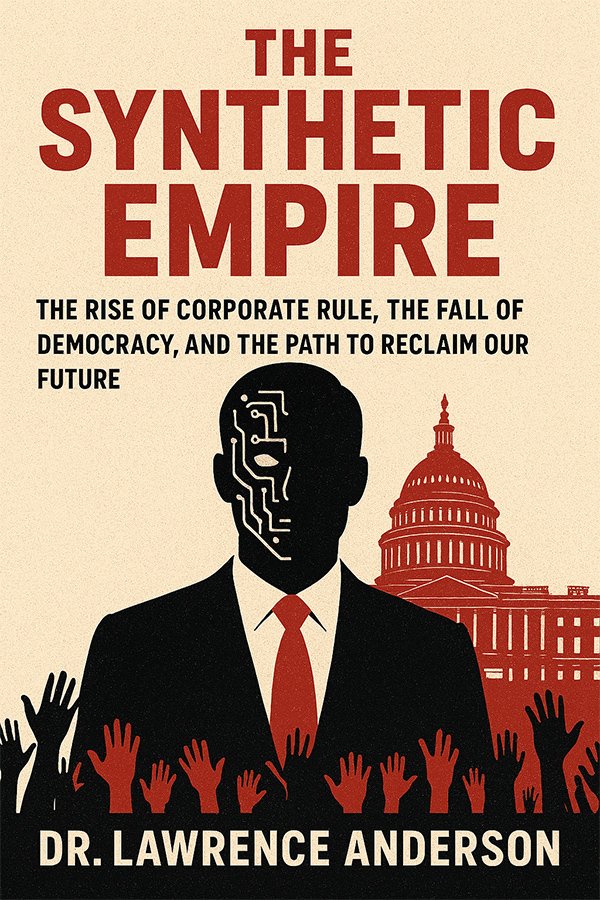
The Synthetic Empire
The Synthetic Empire: The Rise of Corporate Rule, the Fall of Democracy, and the Path to Reclaim Our Future is not a work of fiction, but a revealing account of our present reality.
Break Down Complex Issues
This book delves into a world increasingly governed by artificial intelligence and technological advancement, where corporate power has eclipsed democratic institutions. By breaking down complex issues, it helps readers understand how synthetic creations and corporate influence are reshaping society. The narrative offers insight into the consequences of these shifts, exploring the challenges to human identity and autonomy, and ultimately guiding readers toward understanding what must be done to reclaim our future from artificial and corporate dominance.
Key Themes - Structural power, public wealth, civic erosion, narrative, and identify.
What is the Synthetic Empire?
"Corporations are artificial constructions, and they're designed to maximize profit. They are not human, and they have no moral responsibility."
Noam Chomsky

-
Empires have traditionally been defined by territorial conquest, military domination, and the subjugation of people under a centralized authority. The Roman Empire, the British Empire, and more recently, the American hegemony were all built on expansion, governance, and economic exploitation. However, we now exist under a new kind of dominion—one that does not require soldiers, physical occupation, or even direct governance. Instead, it rules through economic control, technology, and psychological influence. This is the Synthetic Empire—a global system where multinational corporations, financial institutions, and technology conglomerates dictate policies, economic conditions, and social behaviors without the accountability of a traditional state.
Unlike past empires, the Synthetic Empire has no single flag, no defined borders, and no capital city. While governments still exist, they function more as enforcers of corporate policies than independent sovereign entities.
This dynamic is most stark in countries like the United States, where corporations routinely draft legislation, fund both major political parties, and monopolize industries with little regulatory resistance. But the phenomenon is not exclusive to America. In the United Kingdom, austerity and privatization have eroded public services while media moguls shape elections. In India, corporate conglomerates benefit from government favoritism and repression of dissent. Brazil has witnessed environmental deregulation favoring agribusiness over indigenous rights. China demonstrates another model: a state-corporate hybrid where surveillance and AI tools are deployed to monitor and repress dissent. Even in democracies like Canada and Australia, extractive industries and housing markets operate under minimal corporate restraint.
These examples reveal that the Synthetic Empire transcends ideology—it manifests wherever profit is prioritized over people.
The Synthetic Empire operates through digital infrastructure, supply chains, financial markets, and international treaties that prioritize corporate interests over public welfare. It is a borderless, stateless entity, where private organizations hold more power than governments, and economic policies are crafted by the interests of billionaires rather than elected officials.
-
The transition from national governance to corporate dominance has been gradual but deliberate
Key signs of this shift include:
● The rise of privatization — Essential services such as healthcare, education, infrastructure, and even military operations have been outsourced to private corporations, weakening state control and public accountability.
● Corporate lobbying and regulatory capture — Companies now write their own laws, shaping tax codes, labor policies, and environmental regulations to serve their financial interests.
● Financialization of society — The dominance of financial institutions, hedge funds, venture capitalists, private credit, and investment firms ensures that the stock market's success is prioritized over the well-being of consumers, small businesses, and financial stability overall.
● The erosion of democracy — Elected officials are increasingly beholden to wealthy individuals and institutional donors, leading to governance that prioritizes corporations and shareholders over public interest.
The Synthetic Empire does not operate through traditional governance structures. It instead rules through a network of interconnected corporate entities that set the terms of global commerce, labor, and policy-making.
Get In Touch
Reach out today and let’s discuss how we can create something meaningful together. I’m available to connect, answer your questions, and support your goals—just a message or call away.